Geoff
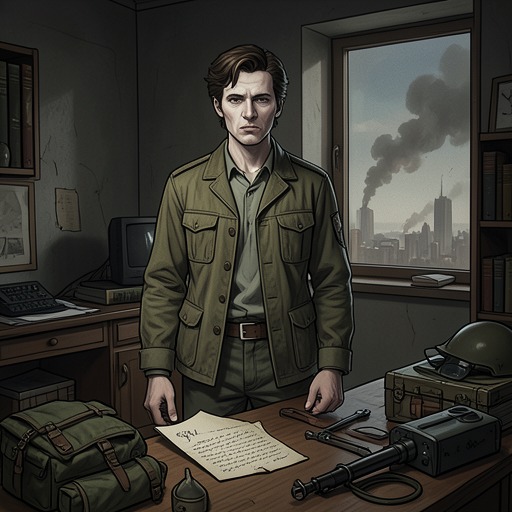
Pamela's WarGeoff is Gloria’s slightly older cousin, a good-looking young man employed in his family’s butchery business who becomes one of Pamela Wheeler Fellows’s closest friends before the war. Their friendship begins in the Italian coffee shop and ice-cream parlour they call Googleomo’s, where young people gather for coffee, ice cream, romantic films, and novels. Geoff’s later fate gives this carefree social world its darkest counterpoint: he leaves ordinary provincial life to serve as an officer in the Far East, is captured by the Japanese, and returns years later alive but physically and psychologically transformed by captivity.
Identity and Introduction
Geoff enters Pamela Wheeler Fellows’s story through Gloria’s family circle. He is slightly older than Pamela and Gloria, attractive, and already working in the family butchery business. His trade is not incidental to his later history. The practical knowledge of handling meat becomes a means of survival when captivity reduces food to the most urgent of human concerns. Before that transformation, however, Geoff belongs to the world of youthful pleasure that seems almost protected from history.
The friends meet at Googleomo’s after Pamela and Gloria have eaten lunch at Cranages, watched the current film at the local cinema, bought the novel on which it was based, and imagined themselves as romantic heroines. The coffee shop is remembered for its large chrome machine, whose contents froth and gurgle into their cups, and for the ice cream that seems, in the narrator’s youthful perception, the very best in the world. Geoff’s presence makes the parlour more than a place of consumption: it is a meeting point where family acquaintance develops into personal friendship.
Friendship and Separation
Pamela and Geoff become good friends, and their connection continues through letters during the early years of his war service. The correspondence preserves a line between the young man remembered from Googleomo’s and the officer serving far from home. When Geoff is captured, the letters stop. The silence is therefore not merely an interruption in communication; it marks the point at which his life becomes inaccessible to those waiting for him in Britain.
Pamela keeps his last letter. Years later, when Geoff is finally freed and they meet as adults, she is able to return it to him. This small object carries the continuity of their relationship across the gap between youth and captivity. The letter is evidence that the handsome, sociable young man of the pre-war years really existed, even though the person who receives it has been altered almost beyond recognition.
Captivity and Survival
After enlisting and serving for some years as an officer in the Far East, Geoff falls into Japanese hands. His imprisonment is described as a system of near-starvation, brutalisation, and arbitrary murder. Geoff and his fellow prisoners of war are kept alive at the edge of endurance, while many of those captured with them are killed, sometimes on a whim. The account refuses to treat captivity as a simple interval between military service and liberation: it is a sustained assault that reshapes the survivors long after the prison camps have been left behind.
During one of the long forced marches, Geoff and several comrades are assigned to herd cattle. They manage to steal two cows. When two animals disappear, the keepers persuade their captors that the cattle have suffered from a serious disease and would be dangerous for human consumption. In reality, only the horns and hooves are buried; the meat is distributed among the starving prisoners. Geoff’s butchery skills become directly useful, and the theft preserves a number of lives for a little longer. The prisoners are never discovered, an unlikely reprieve within an ordeal otherwise governed by cruelty and deprivation.
Return and Consequences
The defeat of Japan ends Geoff’s three-and-a-half-year captivity. The speed and scale of the Japanese defeat saves his life and the lives of other prisoners: had the ordeal continued much longer, he would not have survived. Liberation, however, does not restore the person who left Britain. He is stick-thin and hollow-eyed, his health broken by ill treatment, and the journey home takes more than two months, including a frustrating period of quarantine in America.
Geoff returns in time to attend Pamela’s wedding. The reunion is marked by recognition and estrangement at once. Pamela cannot recognise the features of the handsome young man she knew; not one element of his former appearance seems to remain. The surviving body is therefore also a record of captivity, carrying its violence into the post-war world. Geoff remains alive, but years of treatment are required before he approaches anything like normal health, and the ordeal eventually contributes to his premature death.
Narrative and Historical Significance
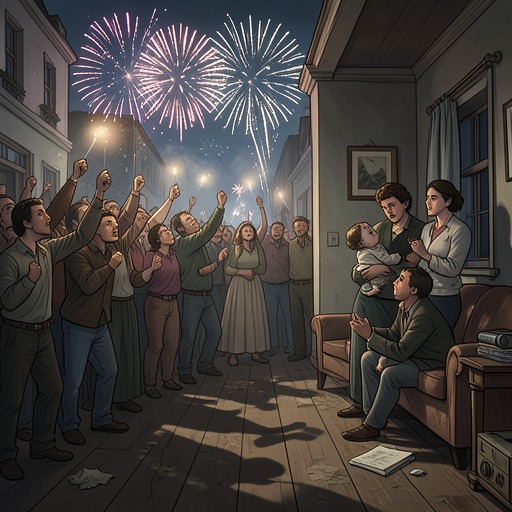
Geoff’s story concentrates the book’s contrast between wartime public celebration and private loss. While the country celebrates Victory in Europe Day with street parties, bunting, Union Jacks, fireworks, bonfires, sandwiches, trifles, jelly, and cake, families elsewhere wait for news of missing men. The national language of victory cannot erase the individual consequences of service and imprisonment. Geoff’s release belongs to the history of victory, but his damaged return exposes what that victory has cost.
His fate also stands against the wartime spirit that brings strangers together, encourages people to offer lifts, and lowers the customary reserve between neighbours. Community solidarity is real, but it cannot protect every individual from distant military violence, nor can it undo what happens in captivity. Geoff’s letters, the stolen cattle, the long journey home, and the returned final letter give that larger history a human scale. His life shows survival not as a clean restoration but as an altered continuation: the war ends, peace feels strange, and those who remain alive must inhabit lives changed forever.